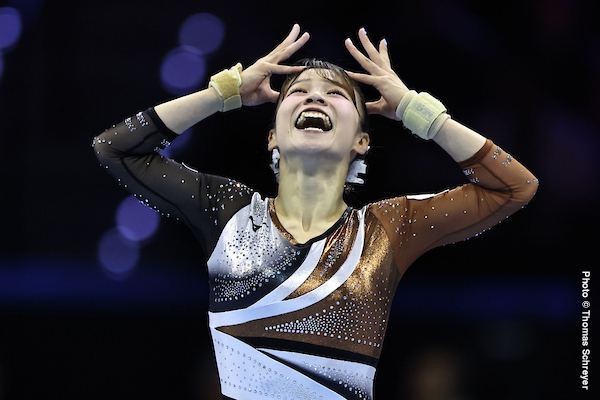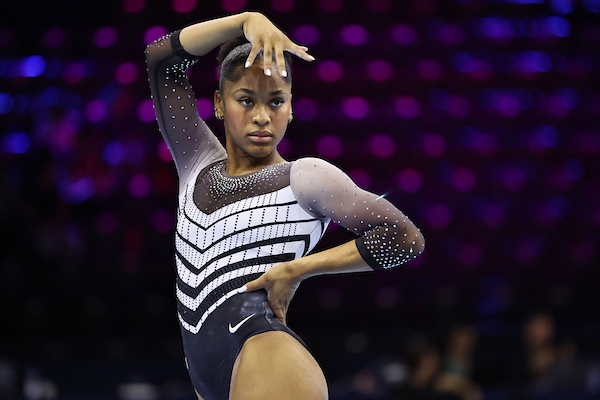
Skye Blakely of the United States showcased a steady and impressive performance across all four apparatus, securing the gold medal in the women’s all-around event at the 2026 World Championships held in Rotterdam on Friday. She achieved a score of 55.733, marking her most significant individual title to date.
Medal standings
Liudmila Roshchina from Russia, competing under the WG2 designation, earned the silver medal with a score of 55.199. Meanwhile, China’s Ke Qinqin captured the bronze with a total of 55.032. Algeria’s Kaylia Nemour, who had qualified first and was considered a top contender for the gold, finished a narrow fourth with a score of 54.998, just 0.034 points behind Ke.
Blakely’s performance
Blakely set the tone for the competition with an outstanding double-twisting Yurchenko vault, scoring 14.200 in the opening rotation. This was followed by an expertly executed routine on the uneven bars, where she demonstrated precise handstands, clean releases, and a stuck dismount, earning her 14.400 and taking the lead with a total of 28.600 after two rotations.
As a two-time U.S. World team gold medalist (2022, 2023), Blakely further solidified her lead on the balance beam, delivering one of the evening’s best performances with a score of 14.200, which extended her lead to over a point as she entered the final rotation.
Needing only a solid routine on the floor to secure her victory, Blakely performed under pressure, scoring 12.933 and completing a flawless four-for-four performance to clinch the gold medal.
Roshchina and Ke’s strong showings
Roshchina remained a contender throughout the competition, starting with a score of 14.033 on vault and following up with a solid 14.333 on uneven bars. She continued her strong performance with one of her best balance beam routines of the championships, scoring 13.433, and finished with a strong floor routine that earned her 13.400, securing her first-ever medal at a World Championship.
Ke stayed competitive throughout the final, highlighted by a vault score of 14.033 and 13.900 on uneven bars. Despite experiencing a fall on her double back dismount on balance beam, she managed to score 13.833, keeping her medal hopes alive. A clean floor routine, scoring 13.266, ultimately secured her the bronze medal by a narrow margin over Nemour.
Nemour’s unexpected challenges
For Nemour, the competition took an unexpected turn from the beginning. The Paris Olympics uneven bars gold medalist, who entered the final with the highest combined difficulty, mistimed her approach on the vault, forcing her to perform a layout instead of the planned double-twisting Yurchenko. This resulted in a score of 12.366, which had a difficulty value of only 3.6 compared to her intended 5.0, leaving her chasing the leaders right from the start.
Nemour fought back on uneven bars, scoring 14.866 despite an early missed connection that required her to add an extra kip cast to handstand. She then delivered an exceptional balance beam routine for 14.500, the highest score on that apparatus during the all-around competition, placing her back in medal contention. However, her final score of 54.998 placed her heartbreakingly close to the podium, replicating a similar outcome from the previous year.
Final standings
Japan’s Aiko Sugihara finished fifth with a score of 54.765, after a consistent performance that included a vault score of 14.266. France’s Elena Colas took sixth place with 54.666, showcasing four solid routines, including a 14.433 on uneven bars and 13.933 on balance beam.
American competitor Claire Pease finished seventh with a total of 54.232. She began with a strong uneven bars routine, scoring 13.833, but lost ground after a fall on her beam series. Pease recovered with a score of 13.733 on the floor exercise and 14.133 on her Cheng vault, earning seventh place in her first World Championships. Spain’s Alba Petisco completed the top eight with a score of 54.198.
The World Championships will continue tomorrow with the first day of individual event finals, featuring events such as floor, pommel horse, and rings for men, along with vault and uneven bars for women.
For more features and reports on the 2026 World Championships, click here.